| 2023 |  
| Tame Impala - Innerspeaker (2010) Tame Impala - Lonerism (2012) |
| 2022 |  |
Louis Cole - Quality Over Opinion (2022) |
| 2021 | .... | |
| 2020 | 
 |
Beck - Hyperspace (2020 Tame Impala - The Slow Rush (2020) |
| 2019 |  |
De Staat - Bubble Gum (2019) |
| 2018 | .... | |
| 2017 | .... | |
| 2016 |  |
Red Hot Chili Peppers - The Getaway (2016) |
| 2015 | .... | |
| 2014 | .... | |
| 2013 | .... | |
| 2012 |  |
Bear In Heaven - I Love You, It's Cool (2012) |
| 2010 |

| Flying Lotus - Cosmogramma (2010) |
| 2009 |

| The Ex - Dizzy Spells (2001) |
| 2008 |

| Manic Street Preachers - Everything Must Go (1996) |
| 2006 |

| Truly - Feeling You Up (1997) |
| 2006 |

| Jeff Buckley - Grace (1994) |
| 2006 |

| dEUS - Pocket Revolution (2006) |
| 2004 |

| Amy Winehouse - Frank (2003) |
| 2004 |

| Orlando Pantera - Radio Special (ca.2000) |
| 2002 |

| N*E*R*D - In Search Of... (2002) |
| 2000 |

| Urban Dance Squad - Artantica (2000) |
| 2000 |

| Radiohead - Kid A (2000) |
| 2000 |

| Beck - Mutations (1998) |
| 1999 |

| Beck - Midnite Vultures (1999) |
| 1997 |

| The Beach Boys - Pet Sounds (1966) |
| 1996 |

| Jon Spencer Blues Explosion - Now I Got Worry (1996) |
| 1995 |

| Truly - Fast Stories... From Kid Coma (1995) |
| 1994 |

| Beastie Boys - Ill Communication (1994) |
| 1992 |

| Jimi Hendrix - Electric Ladyland (1968) |
| 1991 |

| Red Hot Chili Peppers - Blood Sugar Sex Magik (1991) |
| 1991 |

| Captain Beefheart - Trout Mask Replica (1969) |
| 1990 |

| Pixies - Bossanova (1990) |
| 1989 |

| Sonic Youth - Daydream Nation (1988) |
| 1988 |

| Public Enemy - It Takes a Nation of Millions to Hold Us Back (1988) |
| 1987 |

| Eric Dolphy - Out to Lunch (1964) |
| 1986 |

| Ornette Coleman - At the Golden Circle Vol.2 (1965) |
| 1985 |

| Herbie Hancock - Maiden Voyage (1965) |
| 1983 |
 | Malcolm McLaren - Duck Rock (1983) |
| 1982 |

| Tom Tom Club - Tom Tom Club (1982) |
| 1981 |

| Steve Miller Band - Circle of Love (1981) |
| 1980 |

| The Clash - Sandinista (1980) |
| 1979 |


| The Beatles - Red Album (1962-66) The Beatles - Blue Album (1967-70) |
| 1977 |

| ABBA - Arrival (1977) |
Saturday, April 11, 2009
Personal album chronology
This is my personal music chronology: about one album per year, the year in which I got to know it and listen to it. My first album was ABBA's Arrival in 1977, I bought it in spring of 1977 when I was still eleven years old. My musical ABC was ABBA, The Beatles and The Clash...

Monday, March 16, 2009
Added section on ancient images of the Cape Verde Islands
Two sets of images, both shot in 1919 are now available here.
The first is a set of images from a 'Smithsonian African Expedition' (thanks to 'Luvalette').
The second set is from the Shantz Photograph Collection at the University of Arizona. Dr. Homer L. Shantz, botanist, professor, and president of the University of Arizona, visited the Cape Verde Islands in the summer of 1919. The original high resolution images can be seen and downloaded from the UoA.
As far as I can tell, all the images seem to be made in St. Vincent and its town Mindello. But I would very much like to know for sure whether 'the big tree' and 'the old town' don't refer to Santiago.
Thursday, March 05, 2009
Publicatie Heuijerjans stamboom
De afgelopen maanden hebben neef Wil en ondergetekende nog eens behoorlijk wat energie gestoken in het completeren van onze stamboom, die van de familie Heuijerjans. Voor het gemak hanteren we maar even de schrijfwijze zoals die voor ons zelf van toepassing is, maar vele varianten zijn de laatste 2,5 eeuw gebruikt. Bij de publicatie van de documenten die we bezitten zal dit duidelijk worden.
Via Genlias en een bezoek aan het archief van het Rijks Historisch Centrum Limburg hebben we het aantal familieleden met dezelfde naam flink uit kunnen breiden. We hebben ons m.n. gericht op de oudst beschikbare data; recentere familieleden proberen we ook via deze weg op te sporen.
Indien u informatie beschikt die de stamboom completer kan maken, dan zijn wij daar zeer in geinteresseerd. M.b.t. levende personen leggen wij enkel jaartallen vast. We willen het toevoegen van mensen in de boom wel beperken tot degenen die als Heuijerjans zijn geboren, dan wel hun partners.
Publicatie Heuijerjans stamboom
Stamboom in 1 printbaar pdf-bestand
Schrijfwijzen 'Heuijerjans' in de 18e eeuw
Overzicht archief-scans
Heuijerjans genealogie
Wil Heuijerjans
Andreas Heuijerjans
Via Genlias en een bezoek aan het archief van het Rijks Historisch Centrum Limburg hebben we het aantal familieleden met dezelfde naam flink uit kunnen breiden. We hebben ons m.n. gericht op de oudst beschikbare data; recentere familieleden proberen we ook via deze weg op te sporen.
Indien u informatie beschikt die de stamboom completer kan maken, dan zijn wij daar zeer in geinteresseerd. M.b.t. levende personen leggen wij enkel jaartallen vast. We willen het toevoegen van mensen in de boom wel beperken tot degenen die als Heuijerjans zijn geboren, dan wel hun partners.
Publicatie Heuijerjans stamboom
Stamboom in 1 printbaar pdf-bestand
Schrijfwijzen 'Heuijerjans' in de 18e eeuw
Overzicht archief-scans
Heuijerjans genealogie
Wil Heuijerjans
Andreas Heuijerjans
Saturday, November 08, 2008
Mijn afstudeerverslag: "Distributed Font Caching" (1990)
Is nu online (pdf) beschikbaar via de bibliotheek van de TU/e.
In 1990 ben ik bij Océ in Venlo afgestudeerd; prof. dr. dipl-ing. D.K. Hammer was mijn afstudeerdocent. Het betreft het design en de implementatie van een font-cache algoritme op een multi-processor architectuur (gebaseerd op de transputer). Met dit algoritme is een dynamische aansturing mogelijk, waarmee een gebalanceerde afweging kan worden gemaakt tussen processor-belasting (font rasterisatie) en geheugengebruik (font caching).
Monday, July 21, 2008
My major early writings: "Vakantieverslag 1975"
Een boeiend verslag van een enerverende zomervakantie 1975.
Ik ben in Blerick op vakantie geweest
Ik was 3de week van de vakantie op vakantie geweest in Baarlo op de camping. Het was daar heel leuk. Ze deden daar ook spelwetstreiden voor de campingbewoners. Ik mocht ook meedoen. Ik had de zesde plaatse. Ik kreeg toen een postzegelalbum.
In de eerste 2 weken had m'n vader vacantie toen gingen we altijd naar Baarlo zwemmen.
De vierde week was niks bezonders.
Maar de 5de week wel want toen kwamen m'n opa en oma. Die kwamen direkt uit Spanje aan. M'n opa had de boot van hem meegebracht. De volgende dag gingen we met de boot op de maas. Ik zellef mocht ook een keer met de boot varen.
De zesde en laatste week was het nog erg heet. En daarom gingen we elke dag naar Baarlo om bruin te worden en te kunnen zwemmen als we het heet hadden.
[illustratie: de mooie caravan van tante Lies en ome Jo op de camping in Baarlo]
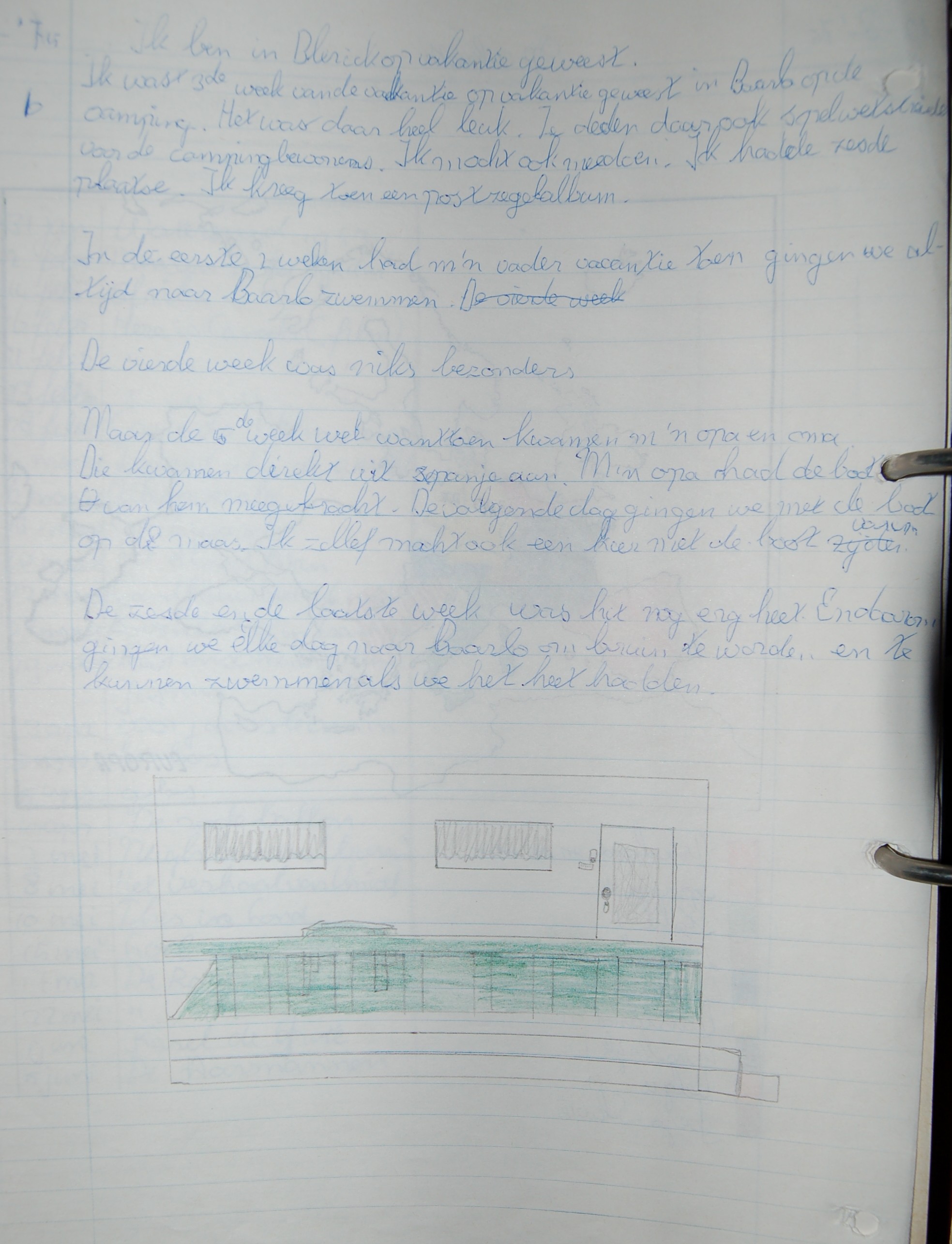
Ik ben in Blerick op vakantie geweest
Ik was 3de week van de vakantie op vakantie geweest in Baarlo op de camping. Het was daar heel leuk. Ze deden daar ook spelwetstreiden voor de campingbewoners. Ik mocht ook meedoen. Ik had de zesde plaatse. Ik kreeg toen een postzegelalbum.
In de eerste 2 weken had m'n vader vacantie toen gingen we altijd naar Baarlo zwemmen.
De vierde week was niks bezonders.
Maar de 5de week wel want toen kwamen m'n opa en oma. Die kwamen direkt uit Spanje aan. M'n opa had de boot van hem meegebracht. De volgende dag gingen we met de boot op de maas. Ik zellef mocht ook een keer met de boot varen.
De zesde en laatste week was het nog erg heet. En daarom gingen we elke dag naar Baarlo om bruin te worden en te kunnen zwemmen als we het heet hadden.
[illustratie: de mooie caravan van tante Lies en ome Jo op de camping in Baarlo]
My major early writings: "Delegend" (1975)
Bij aanvang van het schooljaar 1975-1976 probeerde ik meteen een goede indruk te maken op mijn leraar door een ongegeneerd surrealistisch stuk op tafel te gooien dat zijn weerga niet kent.
NB: een kleine hint moet ik geven: 'delegend' kan het beste worden begrepen als een bijzondere 'diligence' (voor de jonge lezers: dat is een goed geveerde postkoets).
[26-8-'75]
delegend
Toen ik een keer in een delegend zat dacht ik dat ik gek werd. De delegend reed veel harder dan ik ooit gedacht had. Ik moest juist van Blerick naar Tegelen. Het was egt s'omers weer. Ik wou geer in de Maas zwemmen toen ik over de brug van Blerick naar Venlo reed. De Maas heeft wel zuiver genoeg water om er in te zwemmen. Toen we in Venlo kwamen lagen er allemaal grote en kleine zandwegen. De huizen zijn houten hutten.
Toen we vlak bij Tegelen waren gingen we door de weien waar zandige weegjes lagen die telkens stuivden.
In Tegelen aangekomen reden we niet meer zo hard, omdat de paarden al moe waren. Naar 1 uur en 2 min ware we aangekomen. En die eerste rijs vond ik een hele leuke rijs.
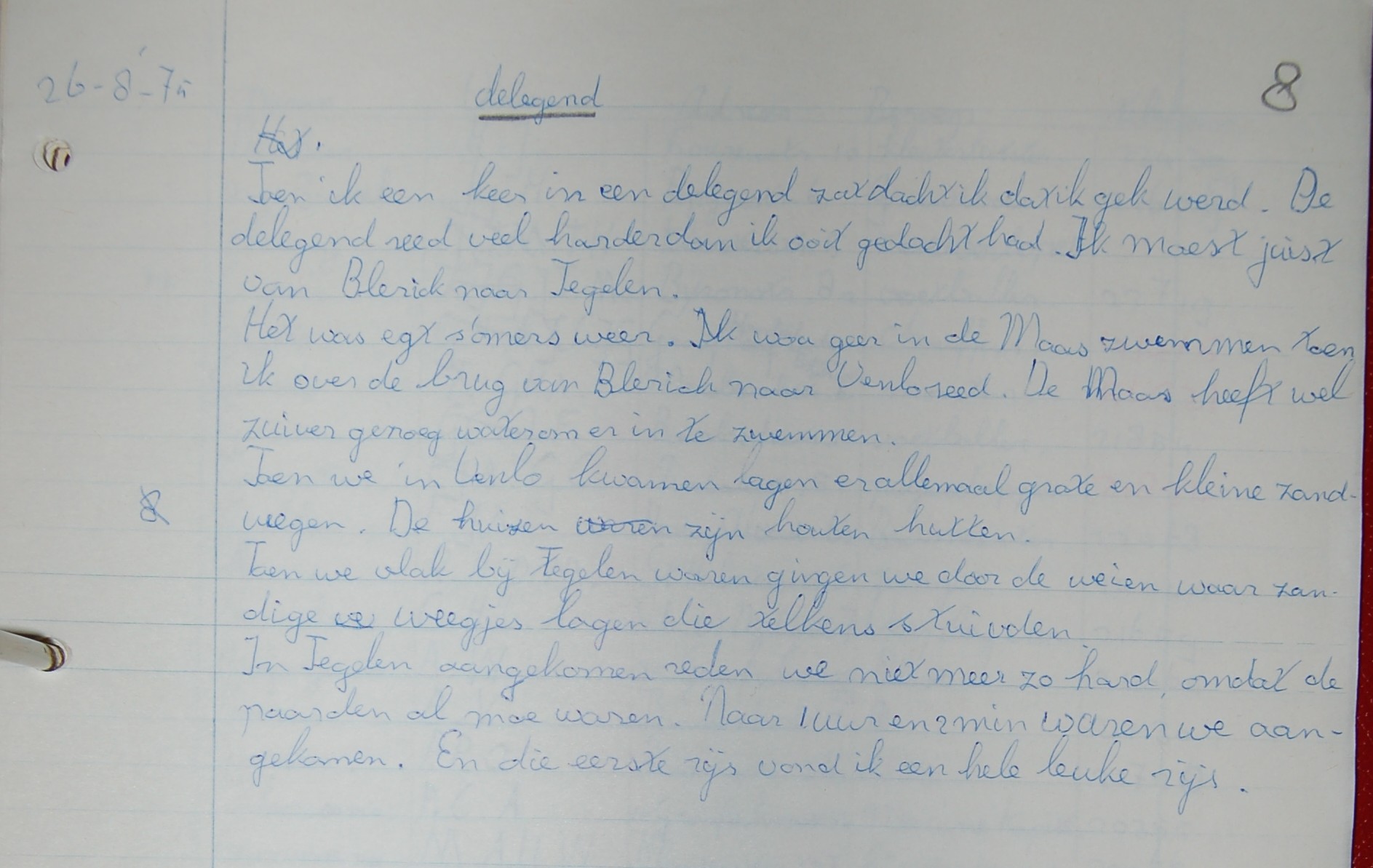
[26-8-'75]
delegend
Toen ik een keer in een delegend zat dacht ik dat ik gek werd. De delegend reed veel harder dan ik ooit gedacht had. Ik moest juist van Blerick naar Tegelen. Het was egt s'omers weer. Ik wou geer in de Maas zwemmen toen ik over de brug van Blerick naar Venlo reed. De Maas heeft wel zuiver genoeg water om er in te zwemmen. Toen we in Venlo kwamen lagen er allemaal grote en kleine zandwegen. De huizen zijn houten hutten.
Toen we vlak bij Tegelen waren gingen we door de weien waar zandige weegjes lagen die telkens stuivden.
In Tegelen aangekomen reden we niet meer zo hard, omdat de paarden al moe waren. Naar 1 uur en 2 min ware we aangekomen. En die eerste rijs vond ik een hele leuke rijs.
My major early writings: "Kinderpostzegelactie 1975"
Herfst 1975 zat ik op de 'vijfde klas' van de Titus Brandsma School in Blerick. Wij werden gevraagd een stuk met journalistieke aspiraties te schrijven over de z.g. Kinderpostzegelactie. Hieronder volgt de transcriptie...
Postzegelactie
Woensdag 1 okt 1975 moest onze klas postzegelen verkopen voor gehandicapten, blinden doven enz. De kinderen ontvangen het geld. Ik heb nu nog 2 zegels over. Bij de mensen waar ik geweest ben waren allemaal vriendelijk. Ik heb nou voor f 27,00 verkocht (weinig hè). Dat zijn allemaal zo'n gekke die geloven er niet in. Maar ja, als iedereen wat erbij legt, komt er wel genoeg geld bij elkaar. De eerste kocht voor f 5,00. De tweede kocht voor f 6,00. De derde kocht voor f 5,00. De vierde voor f 4,00. En de vijfde voor f 7,00, samen f 27,00 (dat klopt). De gehandicapte kinderen kunnen messchien nooit meer lopen als ze wat aan het been hebben (hebben die pech). Wie niet horen kan is een dove. Dat is heel jammer voor de kinderen of mensen. Soms hebben ze een apparaatje op een hoofd aan het oor. Dan kunnen ze een beetje maar verstaan. Bij de postzegelactie kun je postzegelen, kinderkaarten, feestkaarten en kerstkaarten en algemene kaarten kopen. Kaarten kosten f 2,00 het pakje. Postzegels kost f 3,00 het pakje. Ik vind ook jammer voor de blinden dat ze niets kunnen zien. Om altijd met een hond en wandelstok rond te lopen en niets te kunnen zien vind ik helemaal niet leuk voor de blinden. Geef deze kinderen toch een klein beetje geld. Want voor de kinderen is dat helemaal niet leuk. Met een klein beetje geld zijn deze kinderen al genoeg verwent vinden ze.
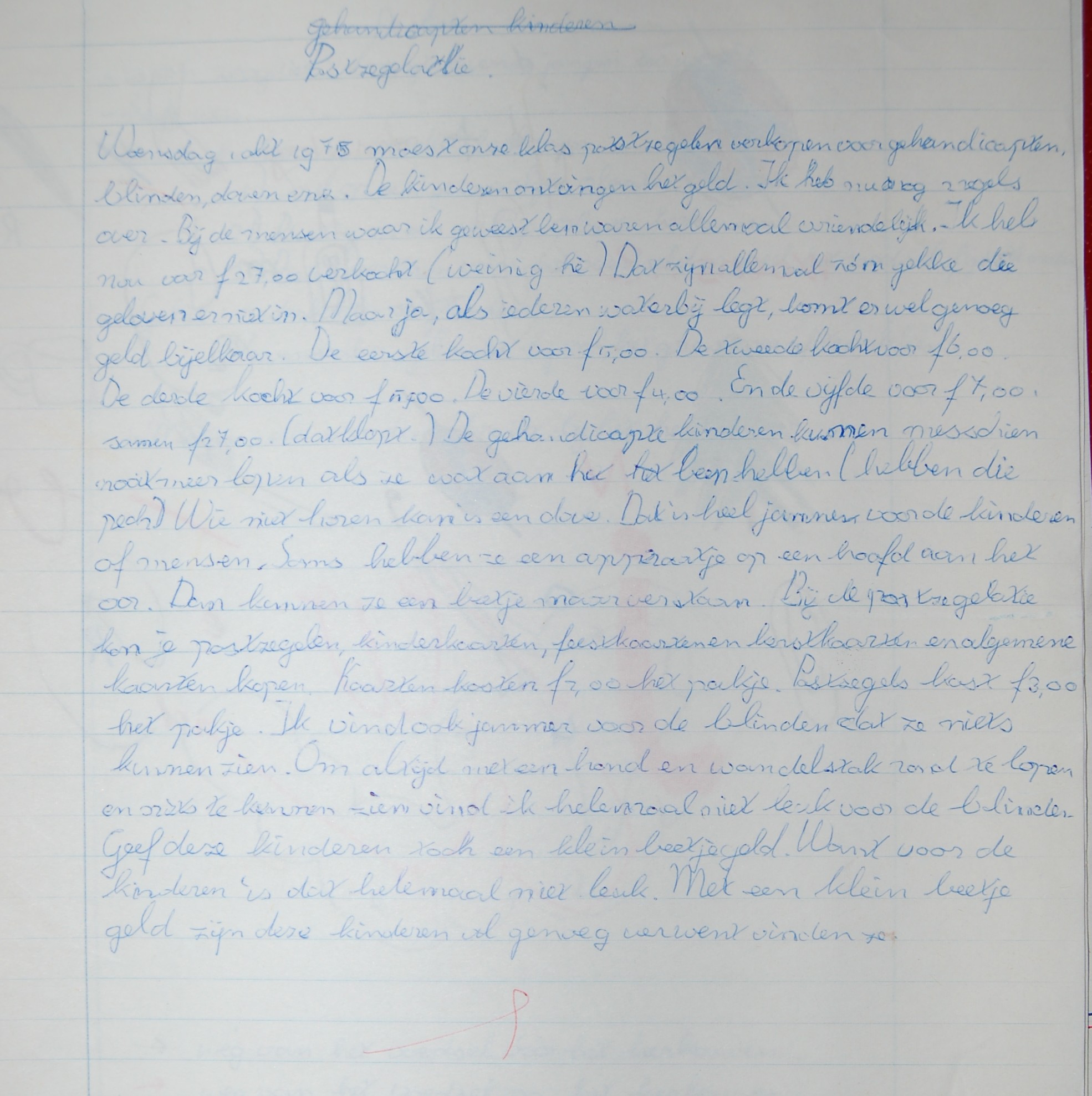
Postzegelactie
Woensdag 1 okt 1975 moest onze klas postzegelen verkopen voor gehandicapten, blinden doven enz. De kinderen ontvangen het geld. Ik heb nu nog 2 zegels over. Bij de mensen waar ik geweest ben waren allemaal vriendelijk. Ik heb nou voor f 27,00 verkocht (weinig hè). Dat zijn allemaal zo'n gekke die geloven er niet in. Maar ja, als iedereen wat erbij legt, komt er wel genoeg geld bij elkaar. De eerste kocht voor f 5,00. De tweede kocht voor f 6,00. De derde kocht voor f 5,00. De vierde voor f 4,00. En de vijfde voor f 7,00, samen f 27,00 (dat klopt). De gehandicapte kinderen kunnen messchien nooit meer lopen als ze wat aan het been hebben (hebben die pech). Wie niet horen kan is een dove. Dat is heel jammer voor de kinderen of mensen. Soms hebben ze een apparaatje op een hoofd aan het oor. Dan kunnen ze een beetje maar verstaan. Bij de postzegelactie kun je postzegelen, kinderkaarten, feestkaarten en kerstkaarten en algemene kaarten kopen. Kaarten kosten f 2,00 het pakje. Postzegels kost f 3,00 het pakje. Ik vind ook jammer voor de blinden dat ze niets kunnen zien. Om altijd met een hond en wandelstok rond te lopen en niets te kunnen zien vind ik helemaal niet leuk voor de blinden. Geef deze kinderen toch een klein beetje geld. Want voor de kinderen is dat helemaal niet leuk. Met een klein beetje geld zijn deze kinderen al genoeg verwent vinden ze.
Sunday, April 27, 2008
Twee aquarellen van Kaapverdie door Quirijn Maurits Rudolph Ver Huell (1820)
Het Maritiem Museum in Rotterdam bezit twee aquarellen van Quirijn Maurits Rudolph Ver Huell, gemaakt in 1820.
Prent 1 ('Porto Praya')
P2161-01A
Porto Praja, op het eiland St. Jago, Kaap Verdische eiland.
Ver Huell, Quirijn Maurits Rudolf
Gezicht op het dorp Praia, op Sao Tiago (een van de Kaapverdische eilanden). Op de achtergrond de berg San Antonio. Van links naar rechts op de voorgrond: het huis van de commandant (met een inheemse vrouw en Ver Huell ervoor); de verkoop van een paar oude laarzen door een medepassagier van Ver Huell, aan de commandant van Praia; een inheemse met een westerse, bontgevoerde winterpelisse aan, vergezeld van een slaaf.


Prent 2 ('apebroodboom')
P2161-02
Baobab.boom (Adansonia digitata) op het eiland St.Jago, Verdische eilanden
Ver Huell, Quirijn Maurits Rudolf
De grote apebroodbomen op Sao Tiago, Kaap Verdische Eilanden met op de achtergrond bergen. De bomen hebben volle kruinen. Bij de bomen zijn verschillende Nederlanders te zien, die op (duiven)jacht zijn. Bij de linker boom staat een ezeldrijver bij een ezel. Rechts op de voorgrond zit Ver Huell, schetsend, bij een grafkruis en enige cactussen en aloe's. Bij hem ligt een vlindernet. (40x57cm)


De baobab van Boa Entrada (bij Assomada)
Deze grote baobab is waarschijnlijk niet de boom die Ver Huell tekende: hier is een beschrijving van een grote baobab vlakbij Praya. Voor zover ik weet bestaat deze niet meer. De baobab van Boa Entrada zijn staat er zo bij 2004.

De gelijkenis met de baobab van Ver Huell is ook niet erg groot. Wat nog wel te vermelden is over de baobab van Boa Entrada, is dat hij nog groter is geweest en door blikseminslag gehalveerd. Dat is wat de lokale bevolking er in ieder geval over weet te vertellen.
De familie Ver Huell
Quirijn Maurits Rudolph Ver Huell (1787-1860) was de zoon van Everhart Alexander Ver Huell, burgemeester van Doesborg. Deze Everhart Alexander had ook nog twee bekendere broers: Christiaan Anthonie (1760-1832), zeeofficier en politicus, en Carel Hendrik (1764-1845), vice-admiraal, politicus en beroemd als Nederlands zeeofficier in dienst van Napoleon.
QMR was ook zeeofficier, maar ook schrijver (o.a. "Schilderachtige Ophelderingen der herinneringen van eene reis naar de Oost-Indien: de Indische (natuur)aquarellen van Q. M. R. Ver Huell").
Zoon van Everhart Alexander Ver Huell, en Anna Aleida Staring. Echtgenoot van jonkvrouwe Louise Christina Johanna Hester de Vaynes van Brakell. Trad als vijftienjarige in dienst bij de marine, en maakte tot zijn ontslag in 1813 carrière bij de Franse zeemacht. Ging in 1807-1808 als adjudant van de gouverneur-generaal naar Oost-Indië. Verbleef vanaf 1810 in Noord-Duitsland, standplaats Hamburg, onder zijn oom Carel Hendrik Ver Huell. Werd in 1813 als kapitein bij de Nederlandse marine uitgezonden naar Oost-Indië, belast met wetenschappelijke waarnemingen en het tekenen en aanleggen van een natuurhistorische verzameling, over welke reis hij in 1835 publiceerde. Daarna equipagemeester bij de rijkswerf te Rotterdam. Publiceerde op het gebied van de letterkunde en de biologie.
Autobiografie (1839): jeugd - deels bij zijn grootouders - in Zutphen en Doesburg en op het buiten Het Enzerinck (bij Vorden), dienst in de marine, waarbij hij in 1805 de slag bij Ambleteuse meemaakte, in Oost-Indië bij de gouverneur-generaal Buyskes, 1811-1812 bij zijn oom in Noord-Duitsland, verblijf en de strijd in Den Helder in 1813. Vertrek naar en verblijf in Oost-Indië, zijn verzameling, de vete Buyskes-Steenboom, en zijn eigen verhouding tot Buyskes, terugkeer, benoeming in Rotterdam, verliefdheden en huwelijk. Gevolgd door ca. veertig aantekeningen over bezoeken aan de werf door vooraanstaande personen.
Prent 1 ('Porto Praya')
P2161-01A
Porto Praja, op het eiland St. Jago, Kaap Verdische eiland.
Ver Huell, Quirijn Maurits Rudolf
Gezicht op het dorp Praia, op Sao Tiago (een van de Kaapverdische eilanden). Op de achtergrond de berg San Antonio. Van links naar rechts op de voorgrond: het huis van de commandant (met een inheemse vrouw en Ver Huell ervoor); de verkoop van een paar oude laarzen door een medepassagier van Ver Huell, aan de commandant van Praia; een inheemse met een westerse, bontgevoerde winterpelisse aan, vergezeld van een slaaf.

Porto Praya, op het Eiland St. Jago. Kaap Verdische Eilanden.

Detail
Huis van de commandant met inheemse en Ver Huell.

Detail
De verkoop van een paar oude laarzen door een medepassagier van Ver Huell, aan de commandant van Praia.

Detail
Een inheemse met een westerse, bontgevoerde winterpelisse aan, vergezeld van een slaaf.

Detail

Detail
In de achtergrond een driemaster met Nederlandse vlag.

Detail
Prent 2 ('apebroodboom')
P2161-02
Baobab.boom (Adansonia digitata) op het eiland St.Jago, Verdische eilanden
Ver Huell, Quirijn Maurits Rudolf
De grote apebroodbomen op Sao Tiago, Kaap Verdische Eilanden met op de achtergrond bergen. De bomen hebben volle kruinen. Bij de bomen zijn verschillende Nederlanders te zien, die op (duiven)jacht zijn. Bij de linker boom staat een ezeldrijver bij een ezel. Rechts op de voorgrond zit Ver Huell, schetsend, bij een grafkruis en enige cactussen en aloe's. Bij hem ligt een vlindernet. (40x57cm)

Baobab Boomen (Adansionia digitata) op het Eiland St. Jago. Kaap Verdische Eilanden.

Detail
Bij de bomen zijn verschillende Nederlanders te zien, die op (duiven)jacht zijn. Bij de linker boom staat een ezeldrijver bij een ezel.

Detail
Bij de bomen zijn verschillende Nederlanders te zien, die op (duiven)jacht zijn.

Detail
Ver Huell, schetsend, bij een grafkruis en enige cactussen en aloe's. Bij hem ligt een vlindernet.
De baobab van Boa Entrada (bij Assomada)
Deze grote baobab is waarschijnlijk niet de boom die Ver Huell tekende: hier is een beschrijving van een grote baobab vlakbij Praya. Voor zover ik weet bestaat deze niet meer. De baobab van Boa Entrada zijn staat er zo bij 2004.

De gelijkenis met de baobab van Ver Huell is ook niet erg groot. Wat nog wel te vermelden is over de baobab van Boa Entrada, is dat hij nog groter is geweest en door blikseminslag gehalveerd. Dat is wat de lokale bevolking er in ieder geval over weet te vertellen.
De familie Ver Huell
Quirijn Maurits Rudolph Ver Huell (1787-1860) was de zoon van Everhart Alexander Ver Huell, burgemeester van Doesborg. Deze Everhart Alexander had ook nog twee bekendere broers: Christiaan Anthonie (1760-1832), zeeofficier en politicus, en Carel Hendrik (1764-1845), vice-admiraal, politicus en beroemd als Nederlands zeeofficier in dienst van Napoleon.
QMR was ook zeeofficier, maar ook schrijver (o.a. "Schilderachtige Ophelderingen der herinneringen van eene reis naar de Oost-Indien: de Indische (natuur)aquarellen van Q. M. R. Ver Huell").
Zoon van Everhart Alexander Ver Huell, en Anna Aleida Staring. Echtgenoot van jonkvrouwe Louise Christina Johanna Hester de Vaynes van Brakell. Trad als vijftienjarige in dienst bij de marine, en maakte tot zijn ontslag in 1813 carrière bij de Franse zeemacht. Ging in 1807-1808 als adjudant van de gouverneur-generaal naar Oost-Indië. Verbleef vanaf 1810 in Noord-Duitsland, standplaats Hamburg, onder zijn oom Carel Hendrik Ver Huell. Werd in 1813 als kapitein bij de Nederlandse marine uitgezonden naar Oost-Indië, belast met wetenschappelijke waarnemingen en het tekenen en aanleggen van een natuurhistorische verzameling, over welke reis hij in 1835 publiceerde. Daarna equipagemeester bij de rijkswerf te Rotterdam. Publiceerde op het gebied van de letterkunde en de biologie.
Autobiografie (1839): jeugd - deels bij zijn grootouders - in Zutphen en Doesburg en op het buiten Het Enzerinck (bij Vorden), dienst in de marine, waarbij hij in 1805 de slag bij Ambleteuse meemaakte, in Oost-Indië bij de gouverneur-generaal Buyskes, 1811-1812 bij zijn oom in Noord-Duitsland, verblijf en de strijd in Den Helder in 1813. Vertrek naar en verblijf in Oost-Indië, zijn verzameling, de vete Buyskes-Steenboom, en zijn eigen verhouding tot Buyskes, terugkeer, benoeming in Rotterdam, verliefdheden en huwelijk. Gevolgd door ca. veertig aantekeningen over bezoeken aan de werf door vooraanstaande personen.
Wednesday, April 02, 2008
"She Got Soul" from '...that's how THE BEATLES were born'
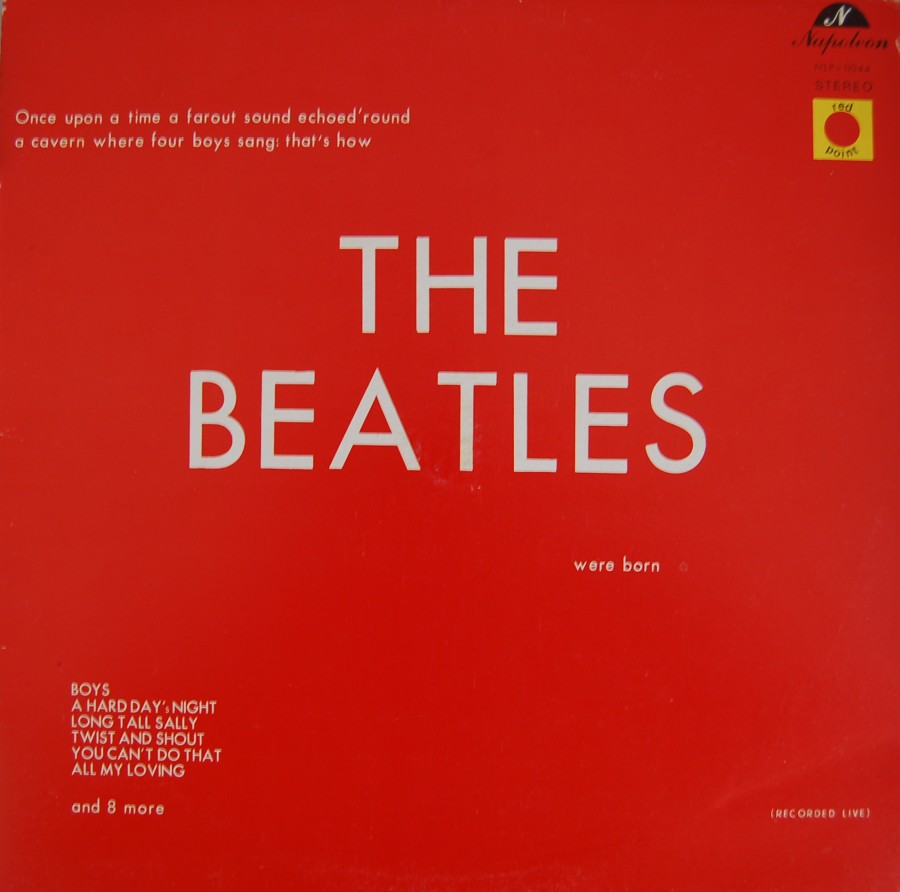
It must have been around 1980 that I bought in our local record store ('Bullit' in Venlo closed a long time ago) a Beatles album for 1 guilder.
The sleeve reads "Once upon a time a farout sound echoed 'round a cavern where four boys sang: that's how THE BEATLES were born." It is 'Recorded Live', sure the A Side is. It is published by 'Napoleon', has some Italian text on the disc label, and certainly is a bootleg.
A side
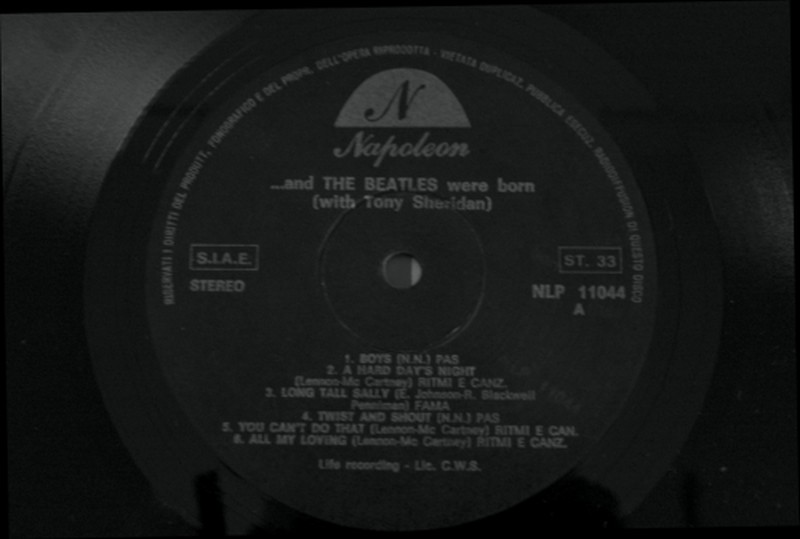
The A side contains a noisy live recording, which is not worth listening to.
B side
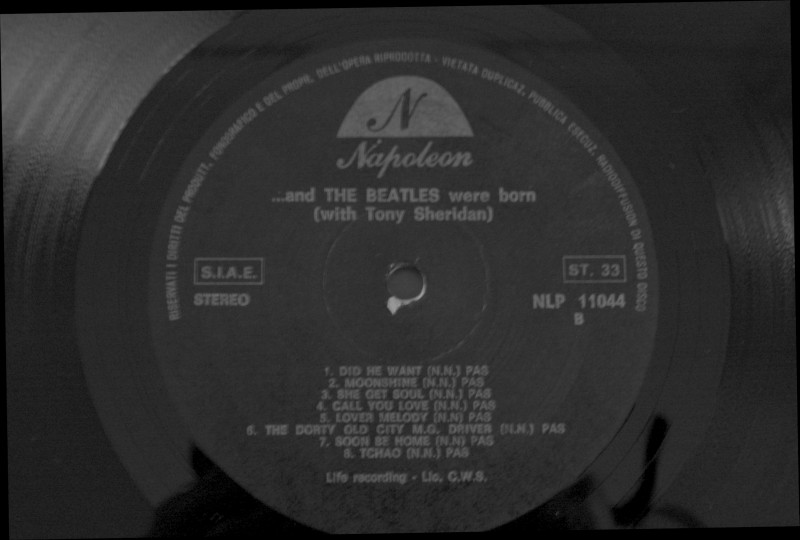
The B side has a somewhat enigmatic content:
1. Did He Want (N.N.)
2. Moonshine (N.N.)
3. She Got Soul (N.N.)
4. Call You Love (N.N.)
5. Lover Melody (N.N.)
6. The Dorty Old City M.G. Driver (N.N.)
7. Soon Be Home (N.N.)
8. Tchao (N.N.)
According to A Bootleg Made in Brazil the B side songs are from Tony Sheridan and performed by The Who. This is certainly not true. The songs on the B side intrigued me a lot and I listened to them very often. Around 1990 this puzzle became almost solved. Thanks to a friend I became a fan of Captain Beefheart and acquired almost all of his work as a musician (of his work as a visual artist, I only keep a book and a video by Anton Corbijn). Some of his early recordings were republished as 'The Legendary A&M Sessions':
1. Diddy Wah Diddy
2. Who Do You Think You're Fooling
3. Moonchild
4. Frying Pan
5. Here I Am I Always Am
This covers most of the B side. What remains to be solved, is who is performing this intriguing song with its psychedelic long guitar solo, called She Got Soul
 , which does not sound like a Captain Beefheart.
[1 Oct 2010] The riddle of 'She Got Soul' is solved! A colleague uploaded the mp3 I posted and one of these applications could find the original directly: the original is called 'Bluebird' (1967) by Buffalo Springfield. This group was a predecessor of the infamous Crosby, Stills, Nash and Young. 'Bluebird' was released on 'Buffalo Springfield Again', but several versions occur. Basically its structure is:
[intro] [corpus] [addendum]
The [addendum] is rather hard/rough compared to the rest of the song.
The 'She Got Soul' version has only:
[intro] [corpus]
There seems to be no decent release of the 'She Got Soul' version available; my LP version is the best, much better than the version on 'Sell Out' (containing rare recordings of Buffalo Springfield); this version does have the [addendum].
What makes the 'She Got Soul' version so special is Neil Young's guitar overdub.
Thursday, December 20, 2007
How I bought an iPod via Ebay/PayPal and had to escalate into a PayPal claim
In October 2007 I purchased an iPod via eBay in the US. The seller seemed trustworthy with many (>>100) transactions and a rating of 98.x%. But the iPod never shipped and I opened a dispute which was escalated into a claim. Here's a detailed overview of how this proceeded.
15 Oct 2007 Bought an 80GB iPod for US $199,99 + US $20,00 shipping. Seller is Ben Brown, Tallahassee, FL 32303 United States, known as eBay seller once.lost, email once.lost@hotmail.com. The item would ship in '2 to 4 business days'.
17 Oct 2007 Email from the seller: "They are drop shipped. When it ships you will receive email notification. Usually within 2-4 business days of purchase. Thanks for your purchase!!!"
22 Oct 2007 Email to seller: "Received no notification after 5 business days - when will it ship?"
22 Oct 2007 Email from the seller: "There was a delay due to bad weather here in pensacola. Please be patient as i am working to get everything back up to speed. You will receive your ipod. I promise. Just because you have not received notification does not mean that item has not been sent. We had tornados here last thursday and they did a lot of damage and caused me delays."
25 Oct 2007 Notification from PayPal that the package will be shipped as a PayPal shipment via U.S. Postal Service, however: "This does not indicate receipt by the USPS or the actual mailing date."
28 Oct 2007 Email to seller: "When will it actually ship?" Got no reply to this email.
31 Oct 2007 Email to seller: "Please give me some feedback!" This mail bounced back: mail to 'once.lost@hotmail.com' can no longer be delivered.
1 Nov 2007 I opened a dispute for not received goods.
10 Nov 2007 I escalated the dispute into a claim.
19 Nov 2007 Email from PayPal indicating that the claim is under investigation.
9 Dec 2007 Email from PayPal. PayPal has taken a decision in my favor: the transaction is rolled back.
19 Dec 2007 Called PayPal to ask how the transaction is rolled back, because no money was written to my PayPal account: the credit card transaction is rolled back and the money is returned to my credit card (MasterCard). Called MasterCard: the money was indeed received.
15 Oct 2007 Bought an 80GB iPod for US $199,99 + US $20,00 shipping. Seller is Ben Brown, Tallahassee, FL 32303 United States, known as eBay seller once.lost, email once.lost@hotmail.com. The item would ship in '2 to 4 business days'.
17 Oct 2007 Email from the seller: "They are drop shipped. When it ships you will receive email notification. Usually within 2-4 business days of purchase. Thanks for your purchase!!!"
22 Oct 2007 Email to seller: "Received no notification after 5 business days - when will it ship?"
22 Oct 2007 Email from the seller: "There was a delay due to bad weather here in pensacola. Please be patient as i am working to get everything back up to speed. You will receive your ipod. I promise. Just because you have not received notification does not mean that item has not been sent. We had tornados here last thursday and they did a lot of damage and caused me delays."
25 Oct 2007 Notification from PayPal that the package will be shipped as a PayPal shipment via U.S. Postal Service, however: "This does not indicate receipt by the USPS or the actual mailing date."
28 Oct 2007 Email to seller: "When will it actually ship?" Got no reply to this email.
31 Oct 2007 Email to seller: "Please give me some feedback!" This mail bounced back: mail to 'once.lost@hotmail.com' can no longer be delivered.
1 Nov 2007 I opened a dispute for not received goods.
10 Nov 2007 I escalated the dispute into a claim.
19 Nov 2007 Email from PayPal indicating that the claim is under investigation.
9 Dec 2007 Email from PayPal. PayPal has taken a decision in my favor: the transaction is rolled back.
19 Dec 2007 Called PayPal to ask how the transaction is rolled back, because no money was written to my PayPal account: the credit card transaction is rolled back and the money is returned to my credit card (MasterCard). Called MasterCard: the money was indeed received.
Wednesday, November 28, 2007
"Description of the Coast of Guinea", Fransisco de Lemos Coelho (1684) republished
 "Description of the Coast of Guinea" republished:
Introduction
The Portuguese text here presented in an English translation was written in or a little before 1684, survives in a manuscript copy written just after 1700, but was only published in the present century. A French translation of the first chapter was published in 1973 but no translation of the whole text has previously appeared. The present English translation was undertaken as part of a project to publish a series of annotated Portuguese texts on Guinea, a project initiated by the distinguished Portuguese scholar, Admiral Avelino Teixeira da Mota; but only, one volume in the series had been published when Teixeira da Mota died in 1982. My English translation would have appeared side by side with the Portuguese text, as re-transcribed by Teixeira da Mota, who would also have supplied original scholarly apparatus and would himself have checked the translation. Instead I can only here offer, first, the translation, less reliable than it would otherwise have been (and therefore to be used in conjunction with the published Portuguese text, against which it should be checked); and, secondly, as much scholarly apparatus as I have been able to generate from the limited sources available to me.
"Description of the Coast of Guinea" republished:
Introduction
The Portuguese text here presented in an English translation was written in or a little before 1684, survives in a manuscript copy written just after 1700, but was only published in the present century. A French translation of the first chapter was published in 1973 but no translation of the whole text has previously appeared. The present English translation was undertaken as part of a project to publish a series of annotated Portuguese texts on Guinea, a project initiated by the distinguished Portuguese scholar, Admiral Avelino Teixeira da Mota; but only, one volume in the series had been published when Teixeira da Mota died in 1982. My English translation would have appeared side by side with the Portuguese text, as re-transcribed by Teixeira da Mota, who would also have supplied original scholarly apparatus and would himself have checked the translation. Instead I can only here offer, first, the translation, less reliable than it would otherwise have been (and therefore to be used in conjunction with the published Portuguese text, against which it should be checked); and, secondly, as much scholarly apparatus as I have been able to generate from the limited sources available to me.In 1953 Academician Damião Peres published the 1684 text, together with a 1669 text, which he proved to be by the same author, being an earlier and shorter version of the same account. He further proved that the author’s name was Francisco de Lemos Coelho, and he briefly discussed Lemos Coelho’s life and career. Three long notes on the Portuguese administration of Guinea in the seventeenth century concluded this edition, no attempt being made to annotate the text in detail. But the 1973 French translation of the first chapter of the 1684 text, by Nize Izabel de Moraes, was accompanied by full annotation and some useful comments on the author’s life. The texts published in 1953 were transcribed from manuscripts preserved in the Biblioteca Nacional in Lisbon. The 1669 text exists in autograph, the 1684 text, which is - as I shall shortly demonstrate - an extended more often than an updated version, exists only in a copy made, a little after 1700, by a writer who occasionally interpolated comments of his own. As the fuller text, the 1684 version has been chosen for the translation; but differences between the two versions will be detailed in the present edition.
P.E.H. Hair, editor (1985)

Sunday, September 02, 2007
Cape Verde Islands: Maps & Cartography
I have added 24 maps - as published in Garcia de Orta's "Cinco seculos de cartografia das ilhas de Cabo Verde" by A. Teixeira da Mota (1961) - to Cape Verde's Maps & Cartograhy.
Then, I have also added a few high resolution images which stem from Nasa's Astronauts' Database.
Monday, August 27, 2007
Cape Verde Islands: Postcards
I published my collection of historical Postcards of the Cape Verde Islands, most of which feature St. Vincent.
Saturday, August 04, 2007
Cape Verde Islands: Maps & Cartography
I have added an overview of Historical Maps of the Cape Verde Islands. My intention is to provide an overview of the cartography history of the Cape Verde Islands. For the island of Santiago the detail vs. correctness of these maps will be shown by identifying the different places on these maps.
The first maps from the Cape Verde Islands date back as far as 1460. The most complete work on this topic most certainly is the 'Portugaliae Monumenta Cartographica', edited by Armando Cortesão and Avelino Teixeira da Mota (1960). Special mention in this area is to be made of Avelino Teixeira da Mota (1920-1982), a Vice-Admiral of the Portuguese Navy who produced many articles, documents and books on the subject.
Sunday, July 22, 2007
Major A.B. Ellis visits the Cape Verde Islands (1885)
Major A.B. Ellis of the 1st West India Regiment created this work from 'notes taken during visits made to the principal islands lying off the West Coast of Africa, in the course of fifteen voyages to and from South and West Africa, between the years 1871 and 1882.'
An excerpt relating to the visit of Sao Antao:
"The road from San Paolo is said to have been made at the instance of one of the former bishops of Santiago, who, considering it his duty to visit every portion of his see, once came to San Antonio. He landed at Paolo, and, instead of proceeding to Ribeira Grande by sea, he attempted to reach that place by land, although there was then no path even of the rudest description; and the natives, on the few occasions upon which they found it necessary to cross the mountains, were obliged to ascend and descend the cliffs and broken heights by means of ropes. When about half the journey had been accomplished, and the bishop had been hauled up a tremendous cliff, his heart failed him at the sight of an equally stupendous one which he would be compelled to descend if he continued in his determination to proceed, and he decided to return. The precipice which now separated him from San Paolo, however, seemed equally terrifying when viewed from above, and he emphatically declined to dangle in mid-air over it again. Being thus unable to advance or recede without risking his valuable neck, he made up his mind to remain where he was. Nothing could shake this determination when once formed; and the mountaineers who had accompanied him left him what food they had with them and went on to Ribeira Grande. The faithful in San Antonio, on learning the awkward predicament in which their spiritual head now was, sent him supplies, clothing, and a tent, which were dragged over the heights by the less timorous peasants, and the ecclesiastical brethren of the bishop at once collected funds and commenced having a road made for his rescue. This was a work which necessarily occupied some years, and before it was completed the timid bishop died; but the inhabitants of San Antonio, finding the road useful, and more than half of it having already been made, carried on the work on their own account until it was finished."
Read his entire account of visits to Sao Vicente and Sao Antao.
This account is also added to the "Cape Verde: Historical Visits".
Wednesday, May 30, 2007
"Black and White Make Brown", Archibald Lyall (1938) republished
 From the original book cover:
Mr. Archibald Lyall has struck completely virgin soil for his new travel book. This is the first work that has ever appeared in English on the Portuguese colonies of either Guinea or the Cape Verde Islands. They may truly be said to be two of the least known territories in Africa, if not in the world—but by no means two of the least important. With the German demand for colonies, and the confused future of the Mediterranean, they may yet leap into front-page news, and Mr. Lyall has much that is topical to say about the strategic importance of Cape Verde, and about the German activities in the Bissagos Islands, off the Guinea coast, where the French newspapers place secret naval bases almost weekly. During his adventures, Mr. Lyall sailed in the last wind-jammer still left in the trans-Atlantic passenger trade, he stayed with alleged cannibals, hobnobbed with some of the most eccentric exiles ever to be washed up on a tropic beach, discovered the worst poet in the world—and at least one very good one."
About St. Vincent (excerpt1)
About life in Portuguese Guinea (excerpt2)
About the Creole ("Kriolo") language (excerpt3)
(Link to my (re)published books at Heuijerjans.net)
Archibald Lyall: Black and White Make Brown, 1938 (excerpt 3)
Soon the republication of Archibald Lyall's visit to the Cape Verde Islands and 'Portuguese Guinea' of 1936 - published as Black and White Make Brown in 1938 - is finished. As a teaser, I will pre-publish some excerpts here.
[About the Creole ("Kriolo") language]
"Creole is to Portuguese much what the Afro-American English of Alabama is to English. Its basis is the fifteenth-century dialect of the Algarve spoken by the early colonists of Cape Verde and imperfectly assimilated by African ears. Since none of the slaves and almost none of the colonists could read or write, the language naturally underwent a strange sea-change in the process of being learnt by frightened black captives from uneducated Portuguese. The grammar was greatly simplified (‘he,’ ‘she’ and ‘it’ are alike simply el), the pronunciation was corrupted (vocé—’you’—has come down to bo), and many African words were incorporated into the language, such as ‘n meaning ‘I’ and ca meaning ‘not’; the latter is found in several of the languages of West Africa, although Capverdians anxious to emphasise the Latin element in Creole at the expense of the Bantu will derive it from nunquam by way of the Portuguese nunca. Papiar, meaning ‘to speak’ (e.g. Bo ca papia Crioulo?—’Don’t you speak Creole?’) is interesting because the Portuguese-based ‘speech’ of Curacão in the West Indies is called the Papiamento—the same word on both sides of the Atlantic.
Three of the chief points where the pronunciation of Creole differs from that of Portuguese are that v becomes b, ch becomes tch, and lh becomes dj. All these pronunciations are archaic and were common in Southern Portugal at the time of the colonisation. ‘Eye,’ for example, is olho in Portuguese, ojo in Spanish (j like ch in ‘loch’) and odjo in Creole. This attracted my notice particularly because I have talked with Jews in the Balkans, who still speak fifteenth-century South Spanish, and their pronunciation is almost the same as that of the Capverdians, whose language is based on fifteenth-century South Portuguese. Where the Creole says odjo, the Spanyol of Salonika or Skoplje says ojo—the j as in French, very close to the Creole dj.
Many difficult words early disappeared or, more probably, were from the outset avoided by the colonists in speaking to their slaves. Thus its similarity to vir, ‘to come,’ caused the replacement of the verb ver, ‘to see,’ by olhar (Creole odjâ), literally ‘to eye,’ just as in the pidgin English of the West Coast words like ‘over’ and ‘done’ are replaced by the unambiguous ‘finish,’ and ‘later on’ and ‘afterwards’ by the equally unmistakable ‘by’m bye.’
On the other hand, the elimination of genders, cases and tenses, and the reduction of several Portuguese words to a single Creole equivalent, are responsible for what is perhaps the greatest difficulty confronting the student of Creole, who finds that its excessive simplification results in a number of ambiguities only resolvable by means of the context. Thus bedjo may be either a ‘kiss’ (Portuguese beijo) or an ‘old man’ (Portuguese velho) and nha may mean ‘my,’ or ‘lady’ or ‘you,’ being a corruption both of minha and of senhora. In Tavares’ Lua Noba (New Moon) the word nha occurs twenty-one times; nine times it is certainly senhora or a senhora, three times minha, and nine times it may equally well be either. I quote it in full, partly to illustrate this philological point and partly as an example of Tavares’ verse in the original.
O nha Madrinha Lua,
Nha Madrinha de Ceu,
Nha botam quel bençom;
Nha Madrinha de meu!
O nha Madrinha branca,
Ca nha esquicê de mi!
Nha dixam ta tchorâ,
Ai, pa nha atcham ta arri!
O nha Madrinha Santa,
Nha pegam na nha mom,
Nha lumiam na nha passo,
Ai, nha botam bençom!
Nha espiam la de Ceu,
Nha djudam co nha cruz!
Nha Madrinha, nha Mai,
Nha Madrinha, nha Luz!
O my Godmother Moon,
My Godmother in Heaven,
Give me your blessing,
Godmother of mine!
O my white Godmother,
Do not ever forget me!
When you leave me I weep for you
And when you return I laugh.
O my holy Godmother,
Take me by the hand,
Light me in my steps,
Ah, give me your blessing!
Look down on me from Heaven, Help me with my cross!
My Godmother, my Mother, My Godmother, my Light!
In the course of centuries other elements entered Creole besides Portuguese and Bantu. Many Brazilian words came in owing to the constant coming and going in the days when first Ribeira Grande and then Praia were ports of call between Portugal and South America. Sailors and others introduced French and Spanish elements. (Santo Antão received an influx of Canarian immigrants at the beginning of the last century when a certain Don Mariano Stinga tried to establish a slave depot on the island.)
Many English words entered the language by three main channels. The first was by way of the English who exploited the salt-pans of Boa Vista and Maio in the eighteenth century. In Boa Vista and São Nicolau a sweetheart is a sicate, which is said to be derived from ‘sick-at-heart.’ A common interjection in São Nicolau is tarote! from the English ‘my troth.’ In Boa Vista the castor-oil plant is castrai instead of ricino. Senhor José Lopes even derives the word morna itself from the English ‘mourner’ and incorporates this theory in his sonnet on the morna:
Do ‘mourn’ inglês vem morna, e é lamentar; e tanto
Que é o coração chorando . . . E que outra prova exigem?
‘Mourner’ é quem a canta, é ‘mourner’ quem a dança.
The only evidence for this seems to be the fact that the morna originated, or at least is first known to have appeared, in the English-influenced island of Boa Vista. On the other hand, similar nostalgic little songs are called mornes by the French métis of Martinique and, since morne (‘sad’) appears a more appropriate description of them than morna (‘tepid’), it seems more probable that the name was first bestowed by French sailors who observed the similarity between the songs of Boa Vista and those of Martinique.
The second channel of entry was St. Vincent, where the English sowed among the natives such words as ovacôte, ovataime (‘overtime’) and grog. Allright and chin-chin are common expressions of amity all through the Islands. The national dish of maize, veal and pork is catchupa, a word said to be derived from the English ‘ketchup.’
A more extensive English element is to be found in the dialects of the Sotavento, where the returned Americanos brought back many expressions with them. A Brava man will call his friend a sanababitche for taking off his trôsas in the quitchen; when he sees a ship he cries Selo! (“Sail Off!’) and when he means ‘let go’ or ‘O.K.’ he says Goahed! or Alrai! When he wants to land he says he will gotchôr (‘go ashore’).
Brava in one sense was a great disappointment to me. Eugénio Tavares wrote in Brava Creole and I hoped to get valuable help in my translation from the many Americanos there who speak fluent English. I found, however, that this was not possible. They did their best but they were not educated men, and their minds entirely lacked the precision and subtlety necessary for accurate translation. Thus an Americano would peruse a stanza carefully and at the end would translate it thus: ‘Dat mean dat guy wishes he was back home,’ or ‘Dat mean dat feller ain’t got nobody to love him,’ or ‘He say he like-a nice-a-lookin’ lady, eh?’—all of which I had already been able to deduce for myself.
The mornas of Tavares deal for the most part with love and with the many things which contribute to form the melancholy of his countrymen. One of the chief among them is sodade, a typically Capverdian state of mind which doubtless dates from the far-away days of the colonisation, when white and black alike felt themselves to be exiles in an inhospitable land. Sodade is a state of heartsick-ness, a nostalgia, a memory of something missing or lost. A lover feels sodade for his lost mistress, an old man for his youth, an exile for his native land. In Andorinhas de Bolta Tavares calls his island ‘the land of Sodade.’
Swallows of the wide seas,
What wind of loyalty
Brings you on this bitter journey
To our land of Sodade?"
Subscribe to:
Posts (Atom)