Sunday, July 22, 2007
Major A.B. Ellis visits the Cape Verde Islands (1885)
Major A.B. Ellis of the 1st West India Regiment created this work from 'notes taken during visits made to the principal islands lying off the West Coast of Africa, in the course of fifteen voyages to and from South and West Africa, between the years 1871 and 1882.'
An excerpt relating to the visit of Sao Antao:
"The road from San Paolo is said to have been made at the instance of one of the former bishops of Santiago, who, considering it his duty to visit every portion of his see, once came to San Antonio. He landed at Paolo, and, instead of proceeding to Ribeira Grande by sea, he attempted to reach that place by land, although there was then no path even of the rudest description; and the natives, on the few occasions upon which they found it necessary to cross the mountains, were obliged to ascend and descend the cliffs and broken heights by means of ropes. When about half the journey had been accomplished, and the bishop had been hauled up a tremendous cliff, his heart failed him at the sight of an equally stupendous one which he would be compelled to descend if he continued in his determination to proceed, and he decided to return. The precipice which now separated him from San Paolo, however, seemed equally terrifying when viewed from above, and he emphatically declined to dangle in mid-air over it again. Being thus unable to advance or recede without risking his valuable neck, he made up his mind to remain where he was. Nothing could shake this determination when once formed; and the mountaineers who had accompanied him left him what food they had with them and went on to Ribeira Grande. The faithful in San Antonio, on learning the awkward predicament in which their spiritual head now was, sent him supplies, clothing, and a tent, which were dragged over the heights by the less timorous peasants, and the ecclesiastical brethren of the bishop at once collected funds and commenced having a road made for his rescue. This was a work which necessarily occupied some years, and before it was completed the timid bishop died; but the inhabitants of San Antonio, finding the road useful, and more than half of it having already been made, carried on the work on their own account until it was finished."
Read his entire account of visits to Sao Vicente and Sao Antao.
This account is also added to the "Cape Verde: Historical Visits".
Wednesday, May 30, 2007
"Black and White Make Brown", Archibald Lyall (1938) republished
 From the original book cover:
Mr. Archibald Lyall has struck completely virgin soil for his new travel book. This is the first work that has ever appeared in English on the Portuguese colonies of either Guinea or the Cape Verde Islands. They may truly be said to be two of the least known territories in Africa, if not in the world—but by no means two of the least important. With the German demand for colonies, and the confused future of the Mediterranean, they may yet leap into front-page news, and Mr. Lyall has much that is topical to say about the strategic importance of Cape Verde, and about the German activities in the Bissagos Islands, off the Guinea coast, where the French newspapers place secret naval bases almost weekly. During his adventures, Mr. Lyall sailed in the last wind-jammer still left in the trans-Atlantic passenger trade, he stayed with alleged cannibals, hobnobbed with some of the most eccentric exiles ever to be washed up on a tropic beach, discovered the worst poet in the world—and at least one very good one."
About St. Vincent (excerpt1)
About life in Portuguese Guinea (excerpt2)
About the Creole ("Kriolo") language (excerpt3)
(Link to my (re)published books at Heuijerjans.net)

Archibald Lyall: Black and White Make Brown, 1938 (excerpt 3)
Soon the republication of Archibald Lyall's visit to the Cape Verde Islands and 'Portuguese Guinea' of 1936 - published as Black and White Make Brown in 1938 - is finished. As a teaser, I will pre-publish some excerpts here.
[About the Creole ("Kriolo") language]
"Creole is to Portuguese much what the Afro-American English of Alabama is to English. Its basis is the fifteenth-century dialect of the Algarve spoken by the early colonists of Cape Verde and imperfectly assimilated by African ears. Since none of the slaves and almost none of the colonists could read or write, the language naturally underwent a strange sea-change in the process of being learnt by frightened black captives from uneducated Portuguese. The grammar was greatly simplified (‘he,’ ‘she’ and ‘it’ are alike simply el), the pronunciation was corrupted (vocé—’you’—has come down to bo), and many African words were incorporated into the language, such as ‘n meaning ‘I’ and ca meaning ‘not’; the latter is found in several of the languages of West Africa, although Capverdians anxious to emphasise the Latin element in Creole at the expense of the Bantu will derive it from nunquam by way of the Portuguese nunca. Papiar, meaning ‘to speak’ (e.g. Bo ca papia Crioulo?—’Don’t you speak Creole?’) is interesting because the Portuguese-based ‘speech’ of Curacão in the West Indies is called the Papiamento—the same word on both sides of the Atlantic.
Three of the chief points where the pronunciation of Creole differs from that of Portuguese are that v becomes b, ch becomes tch, and lh becomes dj. All these pronunciations are archaic and were common in Southern Portugal at the time of the colonisation. ‘Eye,’ for example, is olho in Portuguese, ojo in Spanish (j like ch in ‘loch’) and odjo in Creole. This attracted my notice particularly because I have talked with Jews in the Balkans, who still speak fifteenth-century South Spanish, and their pronunciation is almost the same as that of the Capverdians, whose language is based on fifteenth-century South Portuguese. Where the Creole says odjo, the Spanyol of Salonika or Skoplje says ojo—the j as in French, very close to the Creole dj.
Many difficult words early disappeared or, more probably, were from the outset avoided by the colonists in speaking to their slaves. Thus its similarity to vir, ‘to come,’ caused the replacement of the verb ver, ‘to see,’ by olhar (Creole odjâ), literally ‘to eye,’ just as in the pidgin English of the West Coast words like ‘over’ and ‘done’ are replaced by the unambiguous ‘finish,’ and ‘later on’ and ‘afterwards’ by the equally unmistakable ‘by’m bye.’
On the other hand, the elimination of genders, cases and tenses, and the reduction of several Portuguese words to a single Creole equivalent, are responsible for what is perhaps the greatest difficulty confronting the student of Creole, who finds that its excessive simplification results in a number of ambiguities only resolvable by means of the context. Thus bedjo may be either a ‘kiss’ (Portuguese beijo) or an ‘old man’ (Portuguese velho) and nha may mean ‘my,’ or ‘lady’ or ‘you,’ being a corruption both of minha and of senhora. In Tavares’ Lua Noba (New Moon) the word nha occurs twenty-one times; nine times it is certainly senhora or a senhora, three times minha, and nine times it may equally well be either. I quote it in full, partly to illustrate this philological point and partly as an example of Tavares’ verse in the original.
O nha Madrinha Lua,
Nha Madrinha de Ceu,
Nha botam quel bençom;
Nha Madrinha de meu!
O nha Madrinha branca,
Ca nha esquicê de mi!
Nha dixam ta tchorâ,
Ai, pa nha atcham ta arri!
O nha Madrinha Santa,
Nha pegam na nha mom,
Nha lumiam na nha passo,
Ai, nha botam bençom!
Nha espiam la de Ceu,
Nha djudam co nha cruz!
Nha Madrinha, nha Mai,
Nha Madrinha, nha Luz!
O my Godmother Moon,
My Godmother in Heaven,
Give me your blessing,
Godmother of mine!
O my white Godmother,
Do not ever forget me!
When you leave me I weep for you
And when you return I laugh.
O my holy Godmother,
Take me by the hand,
Light me in my steps,
Ah, give me your blessing!
Look down on me from Heaven, Help me with my cross!
My Godmother, my Mother, My Godmother, my Light!
In the course of centuries other elements entered Creole besides Portuguese and Bantu. Many Brazilian words came in owing to the constant coming and going in the days when first Ribeira Grande and then Praia were ports of call between Portugal and South America. Sailors and others introduced French and Spanish elements. (Santo Antão received an influx of Canarian immigrants at the beginning of the last century when a certain Don Mariano Stinga tried to establish a slave depot on the island.)
Many English words entered the language by three main channels. The first was by way of the English who exploited the salt-pans of Boa Vista and Maio in the eighteenth century. In Boa Vista and São Nicolau a sweetheart is a sicate, which is said to be derived from ‘sick-at-heart.’ A common interjection in São Nicolau is tarote! from the English ‘my troth.’ In Boa Vista the castor-oil plant is castrai instead of ricino. Senhor José Lopes even derives the word morna itself from the English ‘mourner’ and incorporates this theory in his sonnet on the morna:
Do ‘mourn’ inglês vem morna, e é lamentar; e tanto
Que é o coração chorando . . . E que outra prova exigem?
‘Mourner’ é quem a canta, é ‘mourner’ quem a dança.
The only evidence for this seems to be the fact that the morna originated, or at least is first known to have appeared, in the English-influenced island of Boa Vista. On the other hand, similar nostalgic little songs are called mornes by the French métis of Martinique and, since morne (‘sad’) appears a more appropriate description of them than morna (‘tepid’), it seems more probable that the name was first bestowed by French sailors who observed the similarity between the songs of Boa Vista and those of Martinique.
The second channel of entry was St. Vincent, where the English sowed among the natives such words as ovacôte, ovataime (‘overtime’) and grog. Allright and chin-chin are common expressions of amity all through the Islands. The national dish of maize, veal and pork is catchupa, a word said to be derived from the English ‘ketchup.’
A more extensive English element is to be found in the dialects of the Sotavento, where the returned Americanos brought back many expressions with them. A Brava man will call his friend a sanababitche for taking off his trôsas in the quitchen; when he sees a ship he cries Selo! (“Sail Off!’) and when he means ‘let go’ or ‘O.K.’ he says Goahed! or Alrai! When he wants to land he says he will gotchôr (‘go ashore’).
Brava in one sense was a great disappointment to me. Eugénio Tavares wrote in Brava Creole and I hoped to get valuable help in my translation from the many Americanos there who speak fluent English. I found, however, that this was not possible. They did their best but they were not educated men, and their minds entirely lacked the precision and subtlety necessary for accurate translation. Thus an Americano would peruse a stanza carefully and at the end would translate it thus: ‘Dat mean dat guy wishes he was back home,’ or ‘Dat mean dat feller ain’t got nobody to love him,’ or ‘He say he like-a nice-a-lookin’ lady, eh?’—all of which I had already been able to deduce for myself.
The mornas of Tavares deal for the most part with love and with the many things which contribute to form the melancholy of his countrymen. One of the chief among them is sodade, a typically Capverdian state of mind which doubtless dates from the far-away days of the colonisation, when white and black alike felt themselves to be exiles in an inhospitable land. Sodade is a state of heartsick-ness, a nostalgia, a memory of something missing or lost. A lover feels sodade for his lost mistress, an old man for his youth, an exile for his native land. In Andorinhas de Bolta Tavares calls his island ‘the land of Sodade.’
Swallows of the wide seas,
What wind of loyalty
Brings you on this bitter journey
To our land of Sodade?"
Archibald Lyall: Black and White Make Brown, 1938 (excerpt 2)
Soon the republication of Archibald Lyall's visit to the Cape Verde Islands and 'Portuguese Guinea' of 1936 - published as Black and White Make Brown in 1938 - is finished. As a teaser, I will pre-publish some excerpts here.
[About life in Portuguese Guinea]
"It is, in short, an idyllic existence, that of such jungle villages as Tuan. Even then I did not humbug myself into imagining that I would like to spend the rest of my life there, or that we sophisticated Europeans would ever be capable of adapting ourselves to the simple life, however enthusiastic we may be about it in theory; but the people who have never known anything else are perhaps the happiest in the world. They are beautifully mannered, absolutely natural and utterly innocent. (And by that I do not mean to imply that they have not known what we call ‘the facts of life’ ever since they could toddle. The very fact that they have, is one of the reasons for their innocence.) Their lives have very few complications. They have never heard of such a thing as jealousy. Nobody looks cross if you pay more attention to somebody else than to her. In this Utopian society the girls do not even know their ages, let alone lie about them. “How many rains have you?” I asked Cadi in the Creole phrase. She said: “I don’t know,” and skipped laughing away. No one had ever asked her that before.
If civilisation lies in the solution of the problem of how to lead a good and happy life, then these ‘savages’ are ten times as civilized as the Europeans with their treadmill scramble for money and possessions, and their innumerable little fears about their positions and their reputations and their souls and their sins, and twenty times as civilised as the wretched, self-complicated, self-tortured Asiatics. As Van de Velde says, ‘To be happy is an art, and is meritorious in itself.’ He might have added that it is rapidly becoming a lost art."
Wednesday, May 23, 2007
Archibald Lyall: Black and White Make Brown, 1938 (excerpt 1)
Soon the republication of Archibald Lyall's visit to the Cape Verde Islands and 'Portuguese Guinea' of 1936 - published as Black and White Make Brown in 1938 - is finished. As a teaser, I will pre-publish some excerpts here.
[About St. Vicent]
"...there is now nobody to say a mass, since the old black priest of Ribeira Grande died two or three years ago.
I should have liked to have met the old padre. He was reputed to have a hundred children, and his parishioners respected him equally for his fecundity and for his political influence. Most of the old negro priests of Santiago have, or at any rate used to have, large families. Nobody thinks the worse of them, for blood runs warm in the tropics and the morals of the old slave days still survive in the Islands; the old days when the master took any girl he fancied and the blacks mated together like animals.
When I was in St. Vincent, I was told of a recent case in which a woman brought a man into Court for attempted rape. The judge was puzzled, when she had finished her story.
He said: "But there is one thing you have not made clear. What was your reason for resisting this man?"
The woman replied rather lamely that she was defending her virginity.
"Ah, now that is a reason," said the judge. "Let us see if it is true."
The Court thereupon adjourned while the plaintiff underwent a medical examination. When it met again, the doctor reported that she was not a virgin. The case was dismissed on the ground that she had nothing to defend, and she was severely reprimanded for wasting the time of the Court.
Among the lower classes marriage is looked on as an entirely unnecessary bother and expense. The latest statistics show that at least two-thirds of the children born in the Islands are technically illegitimate, and a priest whom Dr. Friedlander met in St. Vincent in 1912 put the proportion there as high as 98 per cent. This does not matter to them, for the Capverdians are very fond of children, and no stigma attaches to bastardy."
Sunday, May 13, 2007
Reunie 1977: DE AVOND
Gisteren was het dan eindelijk zover: met 60 leerlingen en 3 leraren werd de reunie gestalte gegeven. Ik denk dat we wel kunnen stellen dat het een geslaagde avond is geweest; als 'organisatie' kregen we vele bedankjes en veel mensen gaven aan uitermate blij te zijn met dit evenement en ook met de verzorging bij Apollo. Er werd al veel gesproken over een reunie over 10 jaar, of als we allemaal 50 zijn (september 2015)...
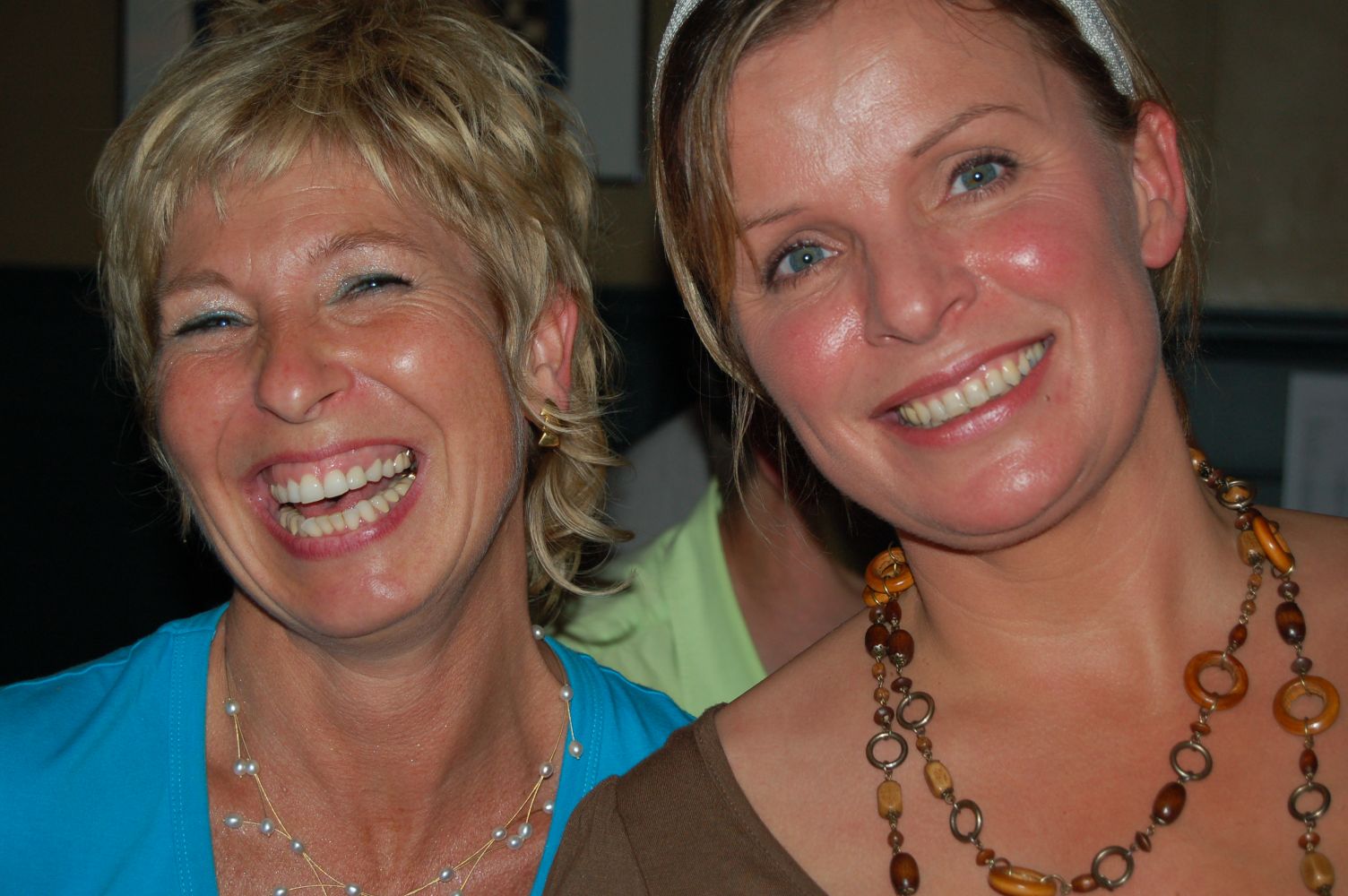
Uiteraard heb ik de foto's ook op de site gezet. Hier alvast een voorproefje (wie zou nou niet bij deze twee schatjes in de klas gezeten willen hebben?!):
 Komende week zal ik de adressen, telefoonnummers en email-adressen rondsturen (maar ze komen niet op internet). Mocht je hier bezwaar tegen hebben, laat het me dan even weten.
Als je nog een reactie wil geven op de reunie, dan kun je hieronder op 'Post a Comment' klikken. Het eenvoudigste is voor 'anoniem' te kiezen en in je tekst je naam eronder te zetten.
Groeten,
Andreas
Komende week zal ik de adressen, telefoonnummers en email-adressen rondsturen (maar ze komen niet op internet). Mocht je hier bezwaar tegen hebben, laat het me dan even weten.
Als je nog een reactie wil geven op de reunie, dan kun je hieronder op 'Post a Comment' klikken. Het eenvoudigste is voor 'anoniem' te kiezen en in je tekst je naam eronder te zetten.
Groeten,
Andreas
 Komende week zal ik de adressen, telefoonnummers en email-adressen rondsturen (maar ze komen niet op internet). Mocht je hier bezwaar tegen hebben, laat het me dan even weten.
Als je nog een reactie wil geven op de reunie, dan kun je hieronder op 'Post a Comment' klikken. Het eenvoudigste is voor 'anoniem' te kiezen en in je tekst je naam eronder te zetten.
Groeten,
Andreas
Komende week zal ik de adressen, telefoonnummers en email-adressen rondsturen (maar ze komen niet op internet). Mocht je hier bezwaar tegen hebben, laat het me dan even weten.
Als je nog een reactie wil geven op de reunie, dan kun je hieronder op 'Post a Comment' klikken. Het eenvoudigste is voor 'anoniem' te kiezen en in je tekst je naam eronder te zetten.
Groeten,
Andreas
Wednesday, May 02, 2007
Venlo's stadswachters van Tajiri

Op de Venlose stadsbrug zijn 2 mei 2007 vier stadswachters onthuld door Koningin Beatrix. Het betreft 4 metalen beelden van de in Baarlo woonachtige kunstenaar Shinkichi Tajiri (1923).
1 mei - dag voor de onthulling
Daags voor de onthulling maakte ik enkele foto's van de verpakte beelden:


2 mei - onthulling
Om 14:00 uur arriveerde Koningin Beatrix per helicopter op de Frederick Hendrikkazerne in Blerick, om 14:30 werden de beelden officieel onthuld:


Zuidoost-wachter (m)


Noordoost-wachter (v)


Noordwest-wachter (m)


Zuidwest-wachter (v)


Sunday, February 25, 2007
1752: Jean Francois Michel - Dagboek van een Mechelaar naar China in 1752 [Dutch]
1752: Jean Francois Michel - Dagboek van een Mechelaar naar China in 1752 [Dutch]
Nu eens een Nederlandse tekst over een historisch bezoekje aan de Kaapverdische eilanden, met dank aan Marc Alcide.Wednesday, November 22, 2006
Interview met Peter Roeven, hoofd van de Titus Brandsmaschool
De redactie heeft Peter Roeven bereid gevonden een klein interview af te staan en even terug te kijken naar de periode dat wij de Titus Brandsmaschool bevolkten.
In de jaren dat wij geboren werden (1964-65 voor de meesten) was dhr. Smits al bijna 20 jaar bij de Titus Brandsma, vanaf 1953 als hoofd. In 1982 volgde dhr. Veugelers hem als hoofd op en hij bleef hoofd tot aan zijn onverwacht overlijden in 1989. Vervolgens werd Peter Roeven hoofd van de Titus Brandsma in 1990 en hij bekleedt deze functie tot op heden.
Door onze hoofdredacteur
In de 4e klas (1974-75) had ik U als meester; in 1976 was U 4 jaar bij de Titus Brandsma. Was klas 6c van 1976-77 Uw eerste 6e klas?
Ja, dat was mijn eerste 6e klas.
Onze jaargang telde 87 leerlingen - die na ons 57. Heeft dit te maken met de oprichting van andere scholen in de jaren '70?
Ja, in die tijd werden er scholen bij de Molenbossen en in het Annakamp gesticht. Een flink deel van de leerlingen van onze school ging daarna naar die scholen. Het kwam eigenlijk wel goed uit, want het gebouw aan de Antoniuslaan moest ontruimd worden en in de Titus Brandsmaschool aan de Laurentiusstraat was niet genoeg plaats voor al die kinderen. In 1974 waren de Antoniusschool en de Titus Brandsmaschool één school geworden. Daarvoor waren het een jongensschool en een meisjesschool. In 1972 was mijn eerste klas (3e klas) de laatste meisjesklas. Daarna zaten de kinderen gemengd.
Wat kunt U zich nog herinneren van onze jaargang? (misschien heeft U nog aantekeningen uit die tijd)
Ik heb hier nog wel een tijdje aantekeningen van gehad, maar die kan ik nu toch echt niet meer vinden. Ik weet wel dat ik het erg leuk vond om de 6e klas te doen. Wat ik ook weet is dat de activiteiten rond het afscheid van de 6e klas in die tijd heel weinig voorstelden in vergelijking met wat nu gedaan wordt. Toch meen ik me te herinneren dat we een of andere speurtocht hadden gemaakt. Vóór die tijd was dat bij mijn weten nog niet gedaan.
Wat voor ontwikkeling heeft 'de jeugd' doorgemaakt in de 35 jaar dat U leraar bent? Wat zit daar achter?
De kinderen zijn nogal wat mondiger geworden. Dat is een ontwikkeling waar bewust naar gestreefd is. Verder lijkt het dat kinderen van nu veel televisie zien en met computers omgaan en daardoor niet meer zo gauw tot bijvoorbeeld lezen komen, omdat andere prikkels zo veel sterker zijn. Verder vind ik dat de verschillen minder groot zijn dan wel eens wordt verondersteld.
Wat voor ontwikkeling hebben de leraren doorgemaakt? Ik kan me herinneren dat b.v. Meester Smits behoorlijk streng kon zijn en dat leraren niet met voornamen werden aangesproken. Hoe en wanneer is die houding van de leraren veranderd?
Vanaf de jaren 70 heeft zich vooral in Nederland (en veel minder in alle ons omringende landen) de ontwikkeling naar een antiautoritaire opvoeding voorgedaan. Deels is dat een reactie op de zeer strenge opvoeding van voor die tijd. Ik denk dat dat goed is, maar ook weer niet moet doorslaan. In de jaren tachtig is het onderwijs in ieder geval veel minder streng geworden. In 1985 kwam de kleuterschool er bij en werden we basisschool. Op de kleuterschool werden de juffen met de voornaam aangesproken. Sinds die tijd zijn ook op onze school steeds meer voor- en achternaam gebruikt. Nog wat later werd nog maar alleen de voornaam gebruikt. In die tijd veranderden veel scholen de aanspreking “meester” in “meneer”. Wij wilden dat ook doen, maar “meester” zat er zo ingebakken, dat we dat maar opgegeven hebben. Om een antwoord op je vraag te geven: Toen meester Veugelers hoofd van de school werd, is de school minder streng geworden.
John Cuijpers woonde in die tijd in de Vossener en wist ook waar U woonde. We gingen 'belletje trekken', de eerste keer was er geen reactie, de 2e keer sprak U ons van boven via een geopende raam toe en nodigde ons uit voor een glaasje sinas: geen straf, maar een beloning! Is dat Uw aanpak?
Belletje trekken zag en zie ik als kattenkwaad dat door ieder kind wel eens wordt gedaan. Word je daar boos over, dan nodigt dat alleen maar uit tot nog vaker belletje trekken. Na een laconieke reactie is het meestal meteen afgelopen.
Worden er veel reünies georganiseerd? Moet U veel reünies aflopen?
Er zijn perioden geweest dat er een heleboel waren, dan weer gaan er jaren voorbij waarin geen enkele reünie wordt georganiseerd.
In de jaren dat wij geboren werden (1964-65 voor de meesten) was dhr. Smits al bijna 20 jaar bij de Titus Brandsma, vanaf 1953 als hoofd. In 1982 volgde dhr. Veugelers hem als hoofd op en hij bleef hoofd tot aan zijn onverwacht overlijden in 1989. Vervolgens werd Peter Roeven hoofd van de Titus Brandsma in 1990 en hij bekleedt deze functie tot op heden.
Door onze hoofdredacteur
In de 4e klas (1974-75) had ik U als meester; in 1976 was U 4 jaar bij de Titus Brandsma. Was klas 6c van 1976-77 Uw eerste 6e klas?
Ja, dat was mijn eerste 6e klas.
Onze jaargang telde 87 leerlingen - die na ons 57. Heeft dit te maken met de oprichting van andere scholen in de jaren '70?
Ja, in die tijd werden er scholen bij de Molenbossen en in het Annakamp gesticht. Een flink deel van de leerlingen van onze school ging daarna naar die scholen. Het kwam eigenlijk wel goed uit, want het gebouw aan de Antoniuslaan moest ontruimd worden en in de Titus Brandsmaschool aan de Laurentiusstraat was niet genoeg plaats voor al die kinderen. In 1974 waren de Antoniusschool en de Titus Brandsmaschool één school geworden. Daarvoor waren het een jongensschool en een meisjesschool. In 1972 was mijn eerste klas (3e klas) de laatste meisjesklas. Daarna zaten de kinderen gemengd.
Wat kunt U zich nog herinneren van onze jaargang? (misschien heeft U nog aantekeningen uit die tijd)
Ik heb hier nog wel een tijdje aantekeningen van gehad, maar die kan ik nu toch echt niet meer vinden. Ik weet wel dat ik het erg leuk vond om de 6e klas te doen. Wat ik ook weet is dat de activiteiten rond het afscheid van de 6e klas in die tijd heel weinig voorstelden in vergelijking met wat nu gedaan wordt. Toch meen ik me te herinneren dat we een of andere speurtocht hadden gemaakt. Vóór die tijd was dat bij mijn weten nog niet gedaan.
Wat voor ontwikkeling heeft 'de jeugd' doorgemaakt in de 35 jaar dat U leraar bent? Wat zit daar achter?
De kinderen zijn nogal wat mondiger geworden. Dat is een ontwikkeling waar bewust naar gestreefd is. Verder lijkt het dat kinderen van nu veel televisie zien en met computers omgaan en daardoor niet meer zo gauw tot bijvoorbeeld lezen komen, omdat andere prikkels zo veel sterker zijn. Verder vind ik dat de verschillen minder groot zijn dan wel eens wordt verondersteld.
Wat voor ontwikkeling hebben de leraren doorgemaakt? Ik kan me herinneren dat b.v. Meester Smits behoorlijk streng kon zijn en dat leraren niet met voornamen werden aangesproken. Hoe en wanneer is die houding van de leraren veranderd?
Vanaf de jaren 70 heeft zich vooral in Nederland (en veel minder in alle ons omringende landen) de ontwikkeling naar een antiautoritaire opvoeding voorgedaan. Deels is dat een reactie op de zeer strenge opvoeding van voor die tijd. Ik denk dat dat goed is, maar ook weer niet moet doorslaan. In de jaren tachtig is het onderwijs in ieder geval veel minder streng geworden. In 1985 kwam de kleuterschool er bij en werden we basisschool. Op de kleuterschool werden de juffen met de voornaam aangesproken. Sinds die tijd zijn ook op onze school steeds meer voor- en achternaam gebruikt. Nog wat later werd nog maar alleen de voornaam gebruikt. In die tijd veranderden veel scholen de aanspreking “meester” in “meneer”. Wij wilden dat ook doen, maar “meester” zat er zo ingebakken, dat we dat maar opgegeven hebben. Om een antwoord op je vraag te geven: Toen meester Veugelers hoofd van de school werd, is de school minder streng geworden.
John Cuijpers woonde in die tijd in de Vossener en wist ook waar U woonde. We gingen 'belletje trekken', de eerste keer was er geen reactie, de 2e keer sprak U ons van boven via een geopende raam toe en nodigde ons uit voor een glaasje sinas: geen straf, maar een beloning! Is dat Uw aanpak?
Belletje trekken zag en zie ik als kattenkwaad dat door ieder kind wel eens wordt gedaan. Word je daar boos over, dan nodigt dat alleen maar uit tot nog vaker belletje trekken. Na een laconieke reactie is het meestal meteen afgelopen.
Worden er veel reünies georganiseerd? Moet U veel reünies aflopen?
Er zijn perioden geweest dat er een heleboel waren, dan weer gaan er jaren voorbij waarin geen enkele reünie wordt georganiseerd.
Wednesday, November 15, 2006
Reunie Titus Brandsma (Venlo-Blerick) 1977
Aangestoken door een reunie-virus dat rondwaart, hebben Hans Timmerman en ik op 6 november besloten een reunie te gaan organiseren voor de 6e klassen van de Titus Brandsma-school, jaargang 1976-77. Eigenlijk hadden we een jaar of 5 geleden al een keer dit plan bedacht, maar kwam de uitvoering toen niet van de grond.
Hans heeft toen al een keer van de school kopieen van de 'klassenlijsten' gekregen, en hiermee zijn we meteen aan de slag gegaan om adres, telefoon en email te achterhalen. Via via dijt de olievlek snel uit en na 1 week hebben we ongeveer 80% van de gegevens binnen!
Op een kleine site kan iedereen de voortgang van het binnenhalen van de gegevens volgen (en zelf helpen natuurlijk). Tevens is hier een plekje voor foto's en linkjes naar 'web presence' van oud-klasgenootjes.
Nu we zo snel het grootste deel van de administratie compleet hebben, kunnen we gaan nadenken over datum, locatie, invulling van de avond en financiele bijdrage (sponsors kunnen zich melden :).
Uiteraard hebben wij zelf ook ideeen hierover, maar je mag ook je ei kwijt door commentaar te geven op deze posting: de eenvoudigste manier om commentaar te geven is via de optie 'Anonymous'.
Groeten,
Andreas
Sunday, July 23, 2006
"The Jesuit Documents" republished
 'Jesuit Documents' (early 17th century) republished:
Description
The Jesuit Mission to Western Guinea was the first one outside Europe. Here the texts of the Jesuit Mission's staff in early 17th century, as collected by Teixeira da Mota and translated by P.E.H.Hair, are completely transcribed and republished.

Sunday, June 18, 2006
Cape Verde Islands: reproduction of West Africa map
Archibald Lyall: Black and White Make Brown (1938)
I intend to republish this book. The republished book will not contain the images - I will publish them here. The map below shows the route Archibald Lyall followed in his two visits to West Africa. What is very nice about this map is, that it shows the locations the different peoples of West Africa live. It is also useful when reading the 'Jesuit Documents'. The map is part of 'Black and White Make Brown', but there is no information on the source of this map and its accuracy. The first half of Lyall's book is dedicated to the Cape Verde Islands; the second half to 'Western Guinea'. | Archibald Lyall Black and White Make Brown, 1938 |
Tuesday, May 30, 2006
Cape Verde Islands: books on its history
So, what's the plan for these books?
As I got interested in the history of the Cape Verde Islands, I saw that the books I wanted to read did not exist, or were not available, or out-of-print, ...
Looking a bit further and with the availability of all sorts of information on the internet, I think there is a lot worth publishing in book form. A book has the advantage to be read and taken anywhere and it is not as tiring as reading from a computer screen - reading a book gives you more time to absord its contents.
Thus, I decided to (re)publish in book form all the material worth it I can lay my hands on. Of course, you cannot just publish other persons stuff. Basically, the material should be free of copyrights, or the owner should grant them to me for publication. The material in the first book (Cape Verde Islands: Historical Visits) is free of copyrights (Project Gutenberg) and granted for one chapter (University of Michigan Making of America).
Publishing these books via Lulu.com enables me to keep everything in my own hands. I can fully determine the contents of the book, its layout, cover, binding, pricing, availability.
Further publications
1. Historical Visits [PUBLISHED]
2. Jesuit Documents: texts assembled by Da Mota, and translated by P.E.H. Hair (available here: http://digicoll.library.wisc.edu/cgi-bin/AfricaFocus/AfricaFocus-idx?id=AfricaFocus.Jesuit01)
3. Black and White Make Brown, by Archibald Lyall, 1938 (out-of-print)
Potentially:
# Several books of Senna Barcelos (Portuguese)
# 'Sailing Letters': Dutch letters which were taken as loot by English pirates
Feedback
If you have hints on copyrights of the mentioned material, or other material you would like to see published, please contact me: andreas[at]heuijerjans.net.
Saturday, April 22, 2006
"1. Cape Verde Islands: Historical Visits" published
1. Cape Verde Islands: Historical Visits

The Portuguese discovered the islands in 1460 and they were almost immediately colonized. From then on a particular mixing of people from West-Africa and Europe were the continuous ingredients of Cape Verde's culture.
The Forgotten Islands, as they are sometimes called now, were historically relevant as a part of the stage when West Europe globally expanded. All of the famous discoverers and navigators took a hold on the Cape Verde Islands: in the early period south west Santiago (Ribeira Grande, Praia) was mostly the place to take fresh water and provisions. Later, in the 19th and early 20th century, Porto Grande (Mindelo) of St. Vicente became an important stop, after the English created a large coal depot for their steam ship industry there.
My personal interest is in re-experiencing the historical development of Cape Verde's culture. A fine way for me to do this, is by reading primary accounts, accounts of people who tell directly from their own experiences. I would like to share with you a dozen of these accounts of famous and unknown travelers to the Cape Verde Islands, which stretch out over the period from 1498 to 1855.
Accounts of: Christopher Columbus, Francis Drake, William Dampier, James Cook, Mungo Park, Joseph Corry, James Holman, Frederick Marryat, Charles Darwin, Edward Wilson Landor, Horatio Bridge, Charles W. Thomas.
Saturday, March 25, 2006
Monday, March 20, 2006
Sunday, March 05, 2006
Bezoek aan Lissabon 23 feb t/m 2 mrt 2006
Korte impressie van een weekje Lissabon - een erg mooie stad met een perfecte mix van klassiek en modern: Lissabon
Saturday, January 14, 2006
Gaten in de evolutie (NRC)
In de NRC van 31-12-2005 een artikel over enkele Gaten in de evolutie. Op 7 januari werden enkele brieven (NRC, 07-01-2006) gepubliceerd. Hier mijn reactie (NRC, 21-01-2006) op een van die brieven:

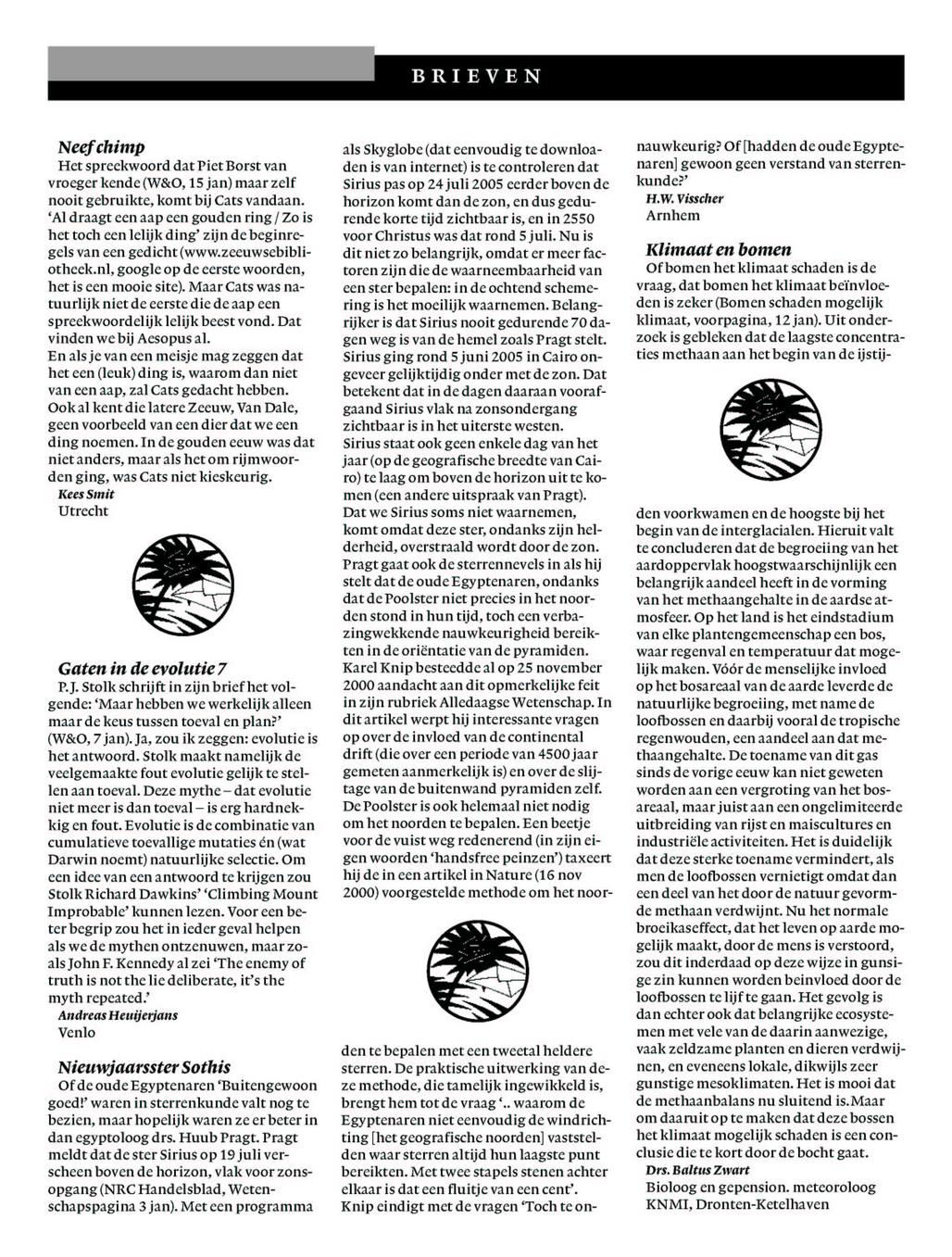
P.J. Stolk schrijft in zijn brief het volgende: "Maar hebben we werkelijk alleen maar de keus tussen toeval en plan?" Ja, zou ik zeggen: evolutie is het antwoord. Stolk maakt nl. de veelgemaakte fout evolutie gelijk te stellen aan toeval. Deze mythe - dat evolutie niet meer is dan toeval - is erg hardnekkig en fout. Evolutie is de combinatie van cumulatieve toevallige mutaties én (wat Darwin noemt) natuurlijke selectie. Om een idee van een antwoord te krijgen zou Stolk Richard Dawkins' Climbing Mount Improbable kunnen lezen. Voor een beter begrip zou het in ieder geval helpen als we de mythen ontzenuwen, maar zoals John F. Kennedy al zei "The enemy of truth is not the lie deliberate, it’s the myth repeated".
Andreas Heuijerjans
Venlo
Subscribe to:
Comments (Atom)